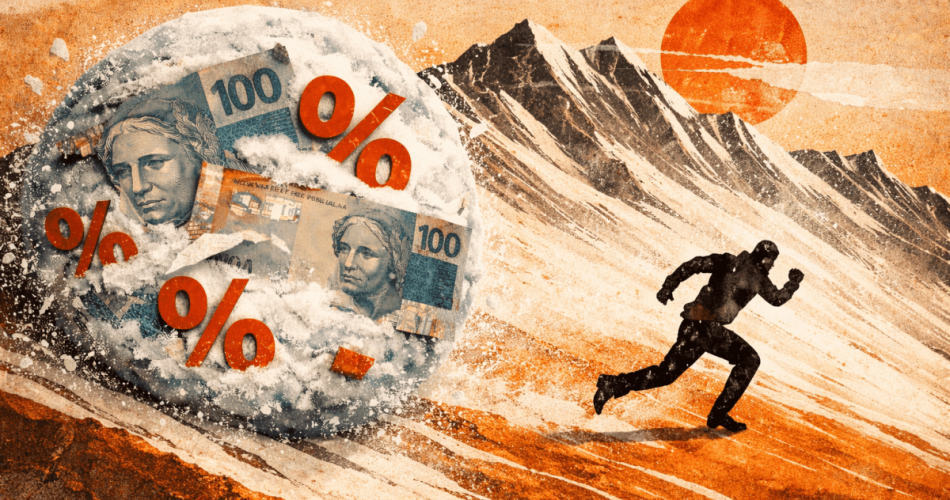
The percentage of Brazilian families with debts reached 80.4% in March 2025, marking the highest rate since the beginning of the Consumer Indebtedness and Default Survey (Peic) historical series. Furthermore, delinquency increased by 38% between 2014 and 2024, according to Serasa data, reflecting a continuous deterioration in consumers’ financial capacity.
In February 2025, the number of delinquent Brazilians reached 81.4 million, an increase of 9 million compared to May 2024, following the end of the Desenrola program. However, this rise came alongside a Selic rate of 14.75% per year in the same month, the highest level recorded in the last 20 years, with only a slight reduction of 0.25 percentage points.
This high basic interest rate directly impacts the cost of debts, which can double in less than two years, according to Fabio Bentes, chief economist of the National Confederation of Commerce (CNC). As a result, families face greater difficulties in settling their commitments, leading to a record share of income devoted to paying financial obligations, as observed in the Central Bank (BC) survey in January 2025.
Meanwhile, withdrawals made by individuals hit a record in December 2025, according to the BC, highlighting a possible withdrawal of funds to cover basic needs and settle debts. On the other hand, the Brazilian Association of Banks (ABBC) estimates that the pace of credit grants will slow in 2026, after a significant increase in indebtedness observed in 2025.
Structural Factors and Economic Context of Over-Indebtedness
The increase in over-indebtedness of Brazilian families reflects both behavioral issues and structural economic factors, which together worsen the financial situation of consumers in the country.
Behavioral Impacts and Causes of Over-Indebtedness
According to a report released by the Central Bank (BC) on May 13, 2025, the growth of over-indebtedness is strongly linked to high interest rates and the low level of financial education among the population. Additionally, easy access to credit, even with high rates, has led to higher delinquency, as pointed out by a study from the Brazilian Association of Credit Bureaus (ABBC). Thus, these combined factors create an adverse scenario for the financial health of Brazilian families.
A survey conducted by the company Dinx reveals that only 9% of national households use financial control techniques to manage income and expenses. On the other hand, only one in four respondents recognizes the need to organize accounts as a fundamental skill. This lack of preparation contributes to misguided financial decisions and rising debts.
At the governmental level, the Desenrola 2.0 program is an emergency response to this problem, providing for the release of resources from the Severance Indemnity Fund (FGTS) for debt payment. However, economist Sérgio Vale, head of MB Associados, classifies this measure as a short-term palliative intervention in an election year context.
Finally, specialists such as Gabriel Barros, from ARX, emphasize that the structural reduction of interest rates depends on strict fiscal policies and effective actions to balance public accounts. This indicates that while monetary policy plays a complementary role, fiscal configuration will determine the pace and impact of these possible changes in the Brazilian economic scenario. Central Bank and other institutions continue monitoring indicators to support future decisions.