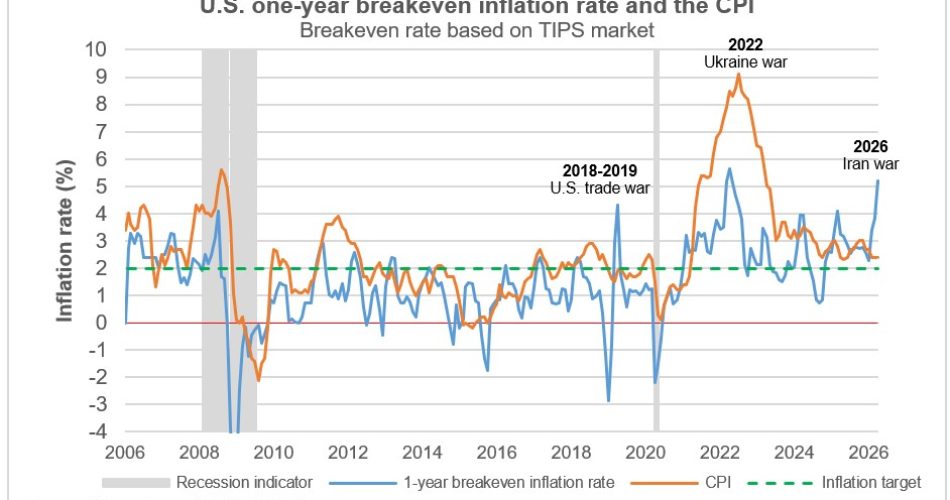
Inflation expectations for the next 12 months rose to 5% after attacks on energy facilities in the Middle East. This increase represents a significant rise compared to the median expectation of 3%, recorded before the start of the conflict, according to a survey conducted by the Federal Reserve Bank of New York.
Official data points out that the consumer price index (CPI) for February increased by 2.4%, while the personal consumption expenditures (PCE) index for January reached 2.8%. However, updates for the PCE for February and the CPI for March will be released in the coming days on April 9 and 10, which may provide a more updated view of the price trajectory.
Despite recent inflationary pressures, financial markets indicate little change in the basic interest rate, the federal funds rate, over the following twelve months. Still, short-term inflation tends to be between 4% and 5% over the next three months, a direct impact of the energy shock caused by tensions in the Middle East.
If the conflict is resolved quickly, projections suggest inflation could return to levels close to 3%. Even so, both current indicators and expectations remain above the 2% target set by the Federal Reserve (Fed), making the scenario challenging for monetary policy.
Monetary authorities should take these short-term expectations into account when formulating their decisions. Uncertainty is increased by the return of protectionism among G-7 nations, which has raised doubts about the sustainability of inflation expectations and the possible temporary or persistent increase in prices due to trade tariffs.
Experts warn of the need to avoid the mistakes observed during the pandemic, especially regarding the analysis of short-term inflation expectations. Joe Brusuelas, a financial sector economist, highlighted that the effects of the energy shock intensify insecurity about price stability for businesses and households.
The recent attacks on the energy sector in the Middle East have lasted about five weeks and, since then, inflation expectations have been monitored daily in the market for inflation-protected securities (TIPS). This constant monitoring helps measure the impact of geopolitical events on the perception of economic agents.
The Federal Reserve faces the challenge of ensuring price stability in an economy that remains at full employment. Thus, the relationship between monetary policy and inflation indicators, both short and long-term, is under continuous evaluation.
With elevated inflation expectations influencing its decisions, the Fed should adjust its discourse according to the developments of geopolitical events and the evolution of these expectations. The conclusion of the process still depends on the analysis of economic data that will be updated this week, which may guide the next steps of the monetary authority.