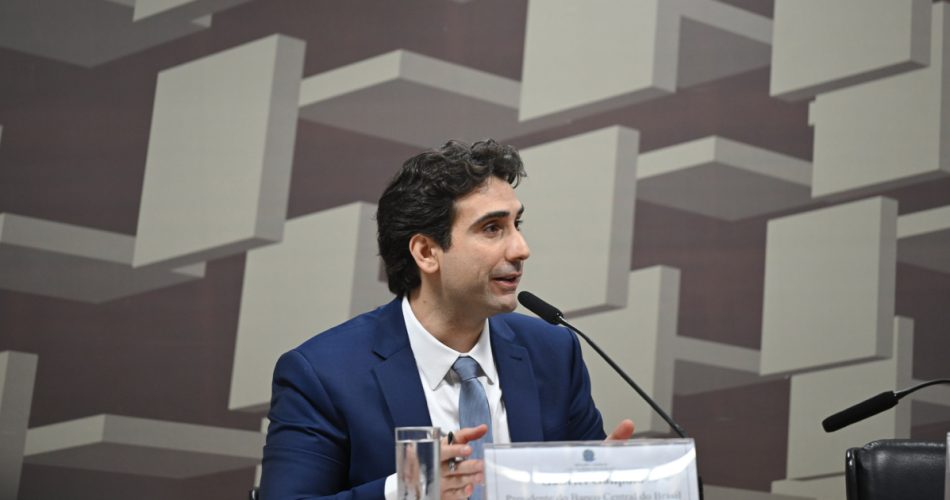
The president of the Central Bank, Gabriel Galípolo, participated in a hearing at the Parliamentary Inquiry Commission (CPI) on Organized Crime on June 8, 2024, advocating for the approval of the Proposed Amendment to the Constitution (PEC) 65/2023. The proposal aims to grant financial, budgetary, and administrative autonomy to the Central Bank, allowing the institution to manage its resources and hiring without prior approval from the federal government.
PEC 65/2023 was drafted by Senator Vanderlan Cardoso (PSD-GO) and is supported by the president of the Senate, Davi Alcolumbre (União Brasil-AP). The report is under the responsibility of Senator Plínio Valério (PSDB-AM). The expectation is that the proposal will be voted on in the Senate plenary the week following Galípolo’s hearing, which would demonstrate an important advance in the process of granting autonomy to the monetary authority.
However, on the same day Galípolo testified before the CPI, the leader of the Workers’ Party (PT) in the Chamber of Deputies, Pedro Uczai (SC), expressed opposition to the PEC by supporting a project that calls for greater external control over the Central Bank. For Uczai, the focus should be on aligning the agency with the values of democracy and national economic policy, ensuring that the Central Bank is subordinate to oversight mechanisms compatible with these principles.
Pedro Uczai emphasized that the mandate of the president of the Central Bank should coincide with the mandate of the head of the Federal Executive to ensure coordinated management and, according to him, to prevent deviations linked to full autonomy. Additionally, the PT leader criticized recent actions of the monetary authority, arguing that some measures contributed to the occurrence of financial scandals, such as the Banco Master case, a prominent episode of systemic risk.
In turn, Gabriel Galípolo stated that the Central Bank does not wish to shirk responsibility for being accountable to the Legislature and society. However, he stressed the importance of increasing oversight and control bodies that do not compromise the bank’s independence in formulating and implementing monetary policies. According to Galípolo, autonomy should be understood as a condition to improve the institution’s governance and efficiency.
The differences between the government coalition and the opposition have intensified the debate about the ideal model for the governance of the Central Bank. While for Galípolo total autonomy corresponds to strengthening economic stability, the PT and its allies advocate for external control that can align the monetary authority’s decisions with the social and political interests elected by the country. This clash reveals deep tensions over the balance between technical independence and political responsibility.
In general, PEC 65/2023 generates expectation and controversy in the National Congress, as its passage has the potential to significantly alter the operational structure of the Central Bank. The conclusion of the process still depends on the vote in the Senate, which is expected to occur in the coming weeks. Furthermore, the project proposed by the PT remains under discussion, pointing to a divided Legislature regarding the direction of Brazilian monetary policy.