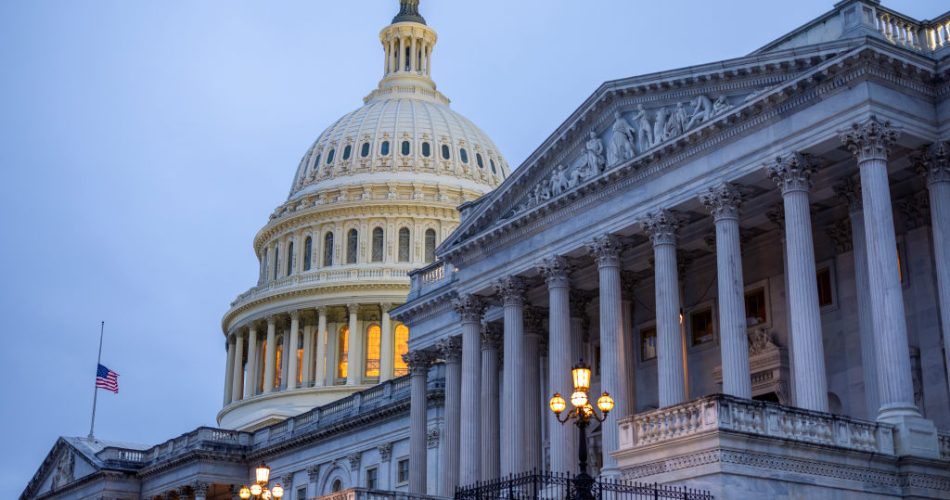
A recent update to the proposed regulation on rewards associated with stablecoins has sparked reactions among banking sector representatives in Washington. The main disagreement revolves around the permission to use balances of these digital currencies to grant benefits to crypto market clients. As such, the issue has created tensions during discussions in the United States Senate Banking Committee.
Senators Thom Tillis (R-N.C.) and Angela Alsobrooks (D-Md.) lead the drafting of the text, which is still under negotiation. However, the final content of the agreement remains undefined, as various stakeholders seek a balance between financial innovation and the security of the traditional banking system. On the other hand, the lack of consensus hinders the approval of broader structural reforms for the cryptocurrency sector.
There are concerns that specific regulation for stablecoin rewards acts as an obstacle to legislative progress in the Senate. Meanwhile, lobbyists connected to banks advocate for stricter rules to limit the expansion of these incentive programs. Finally, the discussions have not yet reached a definitive version, which keeps the topic under constant monitoring by regulators and market agents.
Context on autonomous transportation and safety in Washington D.C.
A survey conducted by Morning Consult in partnership with the Chamber of Progress, in May 2025, revealed that 93% of Washington D.C. residents express concern about distracted drivers on the roads of the United States capital. This perception of risk has influenced public discussion about technological solutions for local traffic.
The company Waymo, specialized in autonomous vehicle technology, already offers a fully autonomous transportation service in Washington D.C. According to company representatives, autonomous cars are not subject to common human limitations such as distraction, fatigue, or alcohol use while driving. Thus, the company states that its vehicles can help reduce accidents caused by human error.
In addition to operating in the American capital, Waymo has expanded its operations to other cities with the aim of increasing road safety. The autonomous driving technology promoted by the company seeks not only to reduce the number of accidents but also to improve transportation accessibility for people with reduced mobility or without a driver’s license.
However, the introduction of this type of service is still the subject of debate among users, regulators, and public safety experts. Meanwhile, the increasing demand for safer alternatives in traffic motivates the progressive development of this technology in Washington D.C. and other major cities in the United States.
The realization of autonomous solutions in urban transportation will be closely observed, as it directly impacts street safety and the mobility of the capital’s residents. The expectation is that the advancement of these technologies will occur in a way that aligns innovation with strict regulatory standards for the benefit of the local population.