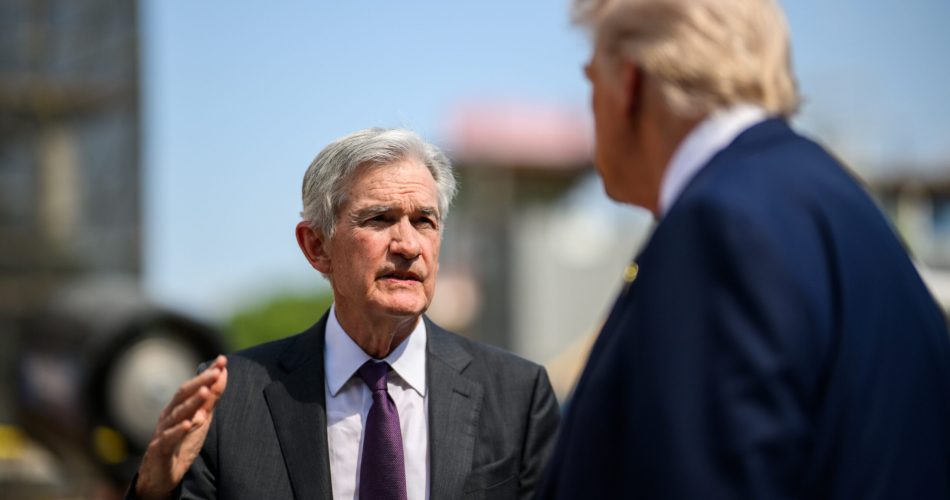
Jerome Powell’s term as chairman of the Federal Reserve (Fed) ends on May 15, 2026, amid a growing clash with President Donald Trump over interest rate policies. Currently, the federal funds target rate is between 3.50% and 3.75%, but Trump advocates a reduction to 1% or less, expanding the debate started at the beginning of his second term, on January 20, 2025.
During Trump’s administration from 2017 to 2021, the main US indices recorded significant gains. The Dow Jones grew 57%, the S&P 500 rose 70%, and the Nasdaq advanced 142%, reflecting a period of strong market appreciation. However, the current tension is escalating with Trump’s interest in promoting significant interest rate cuts, diverging from the Fed’s position, which has given cautious signals.
To replace Powell, Trump nominated Kevin Warsh, a former member of the Federal Open Market Committee (FOMC) from 2006 to 2011, known for prioritizing inflation control over unemployment. The FOMC is the body responsible for defining US monetary policy and has 12 decision-making members who continuously monitor the national economy.
Inflation accumulated over the last 12 months is projected at 3.02% for March 2026, according to data from the Cleveland Fed. Despite this, the Atlanta Fed indicates a 40.2% probability of a 25 basis point rate increase in April and an 18.3% chance of cuts, suggesting an environment of uncertainties and constant evaluation of economic impacts.
Meanwhile, the confrontation involving President Trump and the monetary institution reveals clear differences in economic policy conduct. Therefore, decisions regarding the interest rate must take into account current inflationary pressures and economic growth expectations, a point that will be crucial in the coming months.
Economic Impacts and Geopolitical Context
The US national debt exceeded 39 trillion dollars in March 2026, a scenario worsened by the military conflict that began on February 28 between the US, Israel, and Iran. The confrontation led to the near-total closure of the Strait of Hormuz by Iran, an important route for global oil exports, which raised international fuel prices.
The Strait of Hormuz is responsible for approximately 20% of the world’s daily crude oil transportation, according to data from the Energy Information Administration (EIA). With its blockage, crude oil prices soared, directly impacting fuel costs in the United States, which recorded the highest monthly increase in the last 30 years.
Furthermore, the road, air, and rail transport sectors were strongly affected by high energy costs. The price increase pressured operations in these areas, reflecting challenges for logistics and distribution across various regions of the country.
Simultaneously, the S&P 500 Shiller Price-to-Earnings index showed the second-highest valuation in history in January 2026, supported by the expectation of interest rate cuts promoted by the Federal Reserve (Fed). Market appreciation remains at a high level despite the economic tensions caused by the conflict in the Middle East.
Finally, the inflation report for March 2026, to be released on April 10, is expected to present important data for defining the Fed’s upcoming strategies. The publication will be closely monitored to assess the impact of inflationary pressures resulting from recent shocks in the global energy market.